email us
info@dryfix.net



I remember when Envirovent first really burst on the scene and I must admit their products were a breath of fresh air. Their fans were well designed, stylish, quiet, incorporated good functionality with long term manufacturers warranties and easily replaceable parts. What’s not to like? oh, just the price…..
I’ve never been a fan of the company’s free ventilation surveys apparently carried out by Specialist Ventilation Advisors, which is basically an invitation to quote and is almost always followed up with the advice, your existing fans are poor you need to replace them with not just one, but two of ours.
Here, try our push and pull system, a unit in the loft that delivers fresh air into the house and another in the wall that sucks air out, I guarantee it will resolve your condensation and mould problems. I also guarantee your heating bill will go through the roof too, ohhh and don’t forget to wear your dressing gown if you go to the toilet in the middle of the night because your landings now freezing cold! What insulation, no that’s not really a consideration. Anyhow that’s another subject, I think.
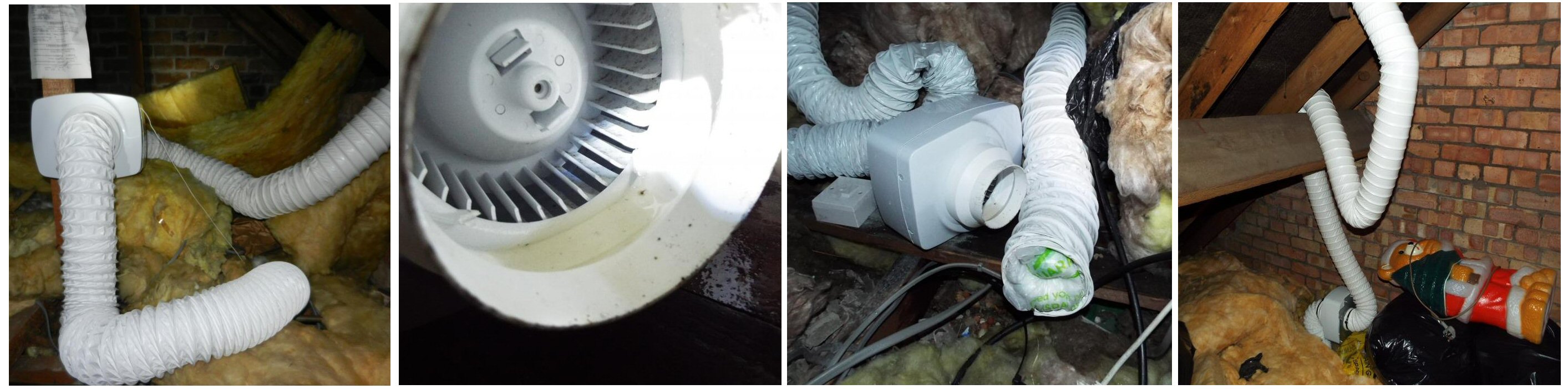
Over the past few years I’ve began to notice cyclone installations in roof spaces. Apparently Envirovent are advising that the cyclone fan can also be installed as an inline system. The company now produce a conversion kit which changes the face plate of the existing cyclone fan allowing an intake duct to be mounted to it. This apparently converts the fan to an inline unit.
Well I’m not convinced. Firstly, I’ve seen multiple of these installations and none of them have performed well. The problem is the intelligent sensors that control the cyclone fans are located within the fan housing and not within the bathroom. As such if the fans located outside of the humid/wet environment how does the sensor work and react accordingly to the conditions. It doesn’t.
Envirovent say this is simple, the air travels up the intake and towards the fans sensor, in practice however I’ve found on multiple installations this does not work well, even if the intake duct is short. It’s also not the most powerful fan on the market. Most inline fans will achieve around 25 – 30 l/s and generally this is what’s required to exhaust to atmosphere, which may often involve a long length of exhaust duct either to a roof vent, soffit vent or gable wall vent. This is not the scenario with a through the wall fan which has the maximum exhaust length over the width of cavity. Subsequently I find the exhaust dust are often full of condensed water.
My opinion is simple, this is a through the wall fan and has clearly been designed as a through the wall fan. So why don’t Envirovent just design and bring to market an inline competitor as appose to advising shabby adaptations.
What’s your opinion, is the cyclone an effective inline fan or through the wall fan?